The tool notices things.
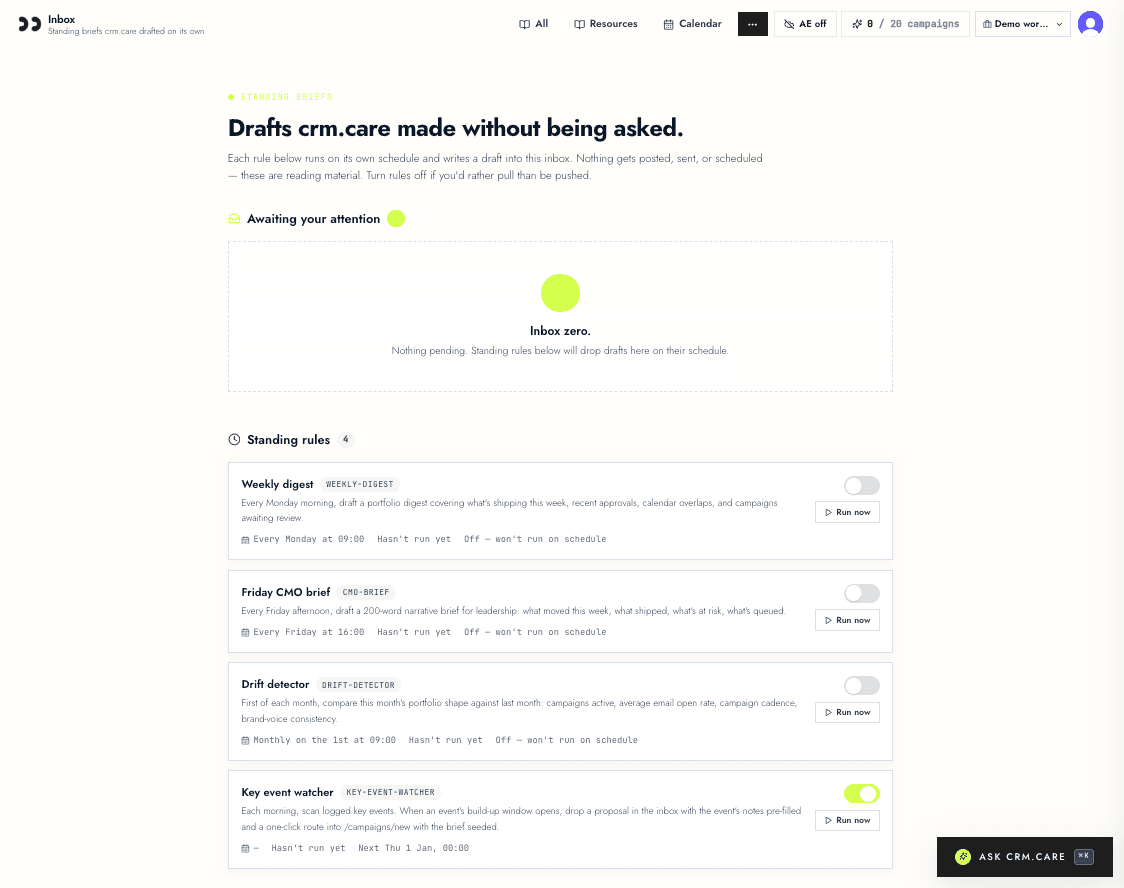
Five autonomous rules run daily, weekly, and on status transitions. Outputs land in an inbox the operator clears in 20 minutes a week instead of 3 hours.
The problem
Marketing operations is one part executing campaigns and three parts noticing patterns. 'We haven't sent to the dormant-pioneer segment in 90 days.' 'The launch in three weeks doesn't have a brief yet.' 'Open rates dropped 15% on the technical-audience emails this month — anyone clocked that?'
The operator who notices these things wins their year. The operator who doesn't gets blindsided by the next quarterly review. Most operators don't notice because no human is going to manually run the cross-checks every Monday morning.
Standing rules notice for you. Configured once, they run asynchronously and emit proposals into an inbox the operator reviews and approves or dismisses in 20 minutes a week.
How it works
The five rules
Weekly digest — every Monday morning, summarises last week's wins and the week ahead. Send count, reply rate movements, what's scheduled.
CMO brief — Friday afternoon, generates a one-page narrative for the marketing leader: what shipped, what's pending, what the CFO would ask. Saves the operator from re-writing the same status update every Friday.
Drift detector — monthly scan. Flags campaigns whose open rate or CTR moved meaningfully off the rolling average. Surfaces the comparable past campaign for context so the operator can spot the structural difference quickly.
Key-event watcher — daily scan. Fires a proposal when a logged key event (Xmas, Black Friday, a conference, a product launch) is approaching and its build-up window has opened but no campaign has been spawned for it yet.
Pre-flight watchdog — automatic on every campaign status transition (draft → approved → in-flight). Checks for missing assets, calendar gaps, AE-not-yet-connected, brand-voice-not-configured. Catches the 'I forgot to set up the landing page' mistake before it becomes a production fire-drill.
The inbox
Each rule's outputs land as proposals in /campaigns/inbox. Each proposal has an action: approve and spawn a campaign, snooze, dismiss, or escalate. Approving the key-event-watcher proposal, for example, spins up a fresh campaign anchored to the event with the recommended lead time.
Proposals dismissed don't get re-emitted by the same rule for that run. Proposals snoozed reappear after the snooze interval expires. Audit trail of every approve/dismiss/snoozed action is visible on the activity tab.
Composable
All five rules ship pre-configured and can be enabled or disabled individually. The underlying engine is composable — custom rules can be added in code (no UI surface yet, but the registry supports it) for team-specific patterns.
Rule outputs respect workspace boundaries. A two-workspace customer gets two separate inboxes; no cross-tenant leakage.
Why it matters
Most marketing-ops tools assume the operator is the agent — they make the decision, the tool executes. Standing rules invert that for the recurring patterns: the tool notices, the operator decides. Half-an-hour of inbox-clearing on Monday replaces three hours of cross-tool reconciliation.
For a team scaling from 1 to 3 marketing-ops people, this is the difference between every new hire learning 'the patterns to watch for' over six months versus the patterns being encoded in the tool from day one. Onboarding compresses; institutional knowledge moves from heads to system.
Related features
See it in your own workspace.
Free 7-day trial. No card. The brief flow takes about five minutes to ship your first campaign — and standing rules (autonomous operators) kicks in from day one.