Same Salesforce data. Three lenses. Different answer.
Absolute / Direct / Indirect contribution computed live from CampaignMember + Opportunity. No tracking pixel. No separate analytics platform. No Apex install.
The problem
Last-touch attribution credits the final touchpoint before the opportunity created. That's structurally biased toward BDR outreach and SDR sequences — they touch deals last. The early-stage content that warmed the deal six months before close — the webinar, the blog post, the newsletter — gets zero credit. It's not that the model is wrong. It's that the model is answering a different question than the one you're trying to answer.
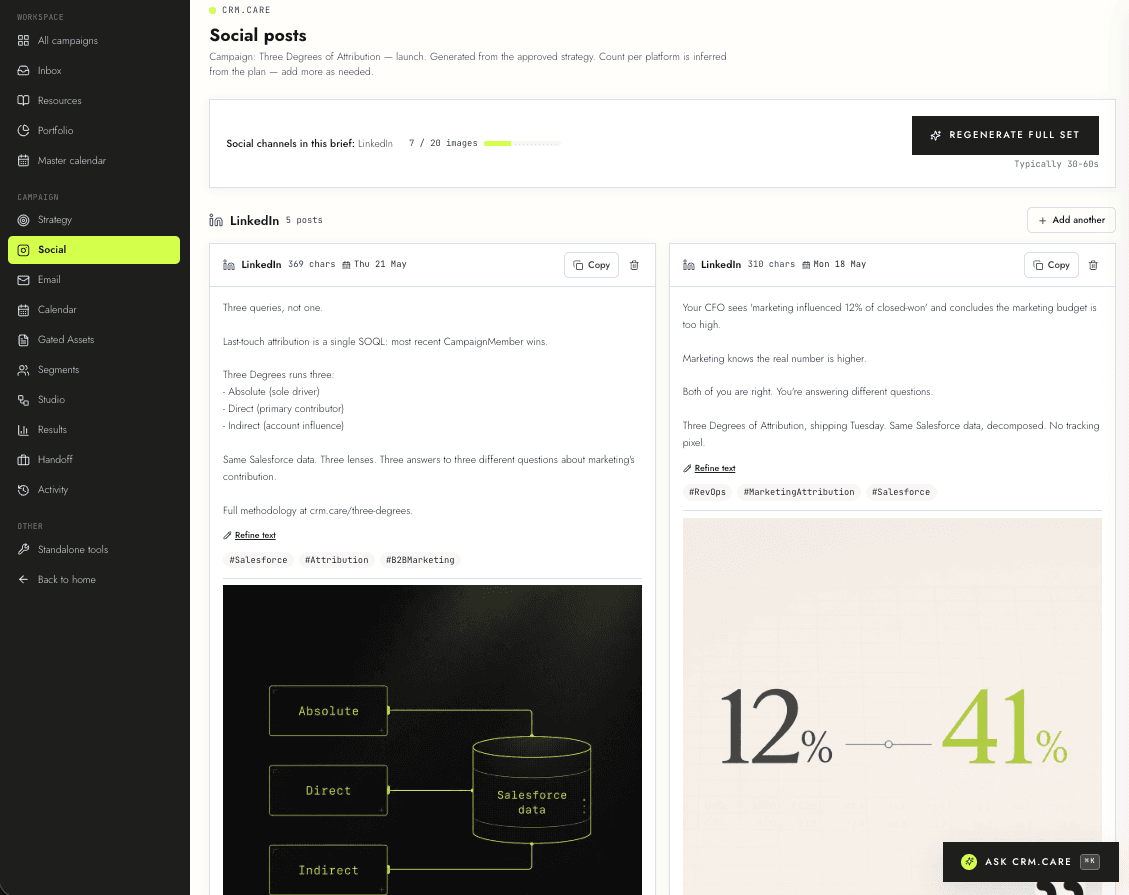
Every quarter the CFO sees 'marketing influenced 12% of closed-won' and decides the marketing budget is too high. Marketing knows the real number is higher. The argument plays out the same way every quarter, with no data to settle it. Quarterly business review becomes Russian roulette.
Three Degrees of Attribution settles the argument with the data the CFO already trusts — Salesforce CampaignMember and Opportunity tables — just decomposed.
How it works
Three queries, not one
Three SOQL queries run live against the customer's connected Salesforce. Same data as the existing reports, no tracking pixel, no separate analytics platform, no Apex install.
Absolute — opportunities where this campaign was the sole CampaignMember influence. The conservative number. Maps roughly to what last-touch attribution would show.
Direct — opportunities with no PCS, but where a campaign-member contact has an OpportunityContactRole. The primary-contributor tier — clearly material to the deal alongside other touches.
Indirect — opportunities at accounts that had campaign members but no direct contact-role match. The 'warmed the account' tier — the long tail your last-touch report ignores.
The Salesforce connection
Read-only OAuth on three SF scopes: CampaignMember, Opportunity, OpportunityContactRole. No write access. No Apex install. The customer's existing SF admin can approve the scopes in two minutes without needing to involve their developer team.
Once connected, every campaign synced to Salesforce gets a Results tab populated with its Three Degrees breakdown. Click between Absolute, Direct, Indirect to flip the lens — same data, different question.
What the breakdown looks like
Median shift in pilot data: 12% (last-touch) → 41% (Absolute + Direct + Indirect combined). Same closed-won dataset. The shape of the curve matters: roughly 12% Absolute, 25% Direct, 4% Indirect for a typical content-led B2B campaign. Heavy-paid or heavy-events campaigns shift the mix.
A baked-in demoAttribution fixture lets a prospect see exactly what the breakdown looks like before connecting their own Salesforce — useful for sales conversations and for the 60-second answer to 'what does the output look like?'
Why it matters
The argument stops being opinion versus opinion. The CFO sees the same source data the existing Salesforce reports use, just decomposed. Marketing's contribution becomes observable, not asserted. The budget conversation moves from 'do we trust your tracking pixel' to 'do we agree on which lens applies to which decision.'
For the marketing leader, the implication is more strategic: knowing the Indirect number means you can defend long-arc content investment (the blog, the newsletter, the podcast) against last-touch-driven pressure to cut it in favour of more BDR seats.
Related features
See it in your own workspace.
Free 7-day trial. No card. The brief flow takes about five minutes to ship your first campaign — and three degrees of attribution kicks in from day one.