The brand-voice doc nobody reads — except the model does.
Voice samples, dos and don'ts, value props, colour palette. Configured once, propagates everywhere. The 20-minute 'this doesn't sound like us' edit cycle compresses to two.
The problem
Every demand-gen team has a brand-voice doc. Every brand-voice doc is 14 pages. Every junior copywriter has skimmed it once. The result: drift across every output, plus 20 minutes of senior-editor cleanup per asset, plus a volume cap that's editing capacity, not idea pipeline.
Three drafters interpret 'our voice' three different ways. Junior copywriters default to AI-generic. Senior editors burn hours rewriting. The brand-voice doc nobody reads gets longer with each rewrite because the team keeps adding 'and we don't say <thing>' rules, but the document is fundamentally not the right surface — nobody is going to read 14 pages before drafting a 200-word LinkedIn post.
The existing brand-voice tools (Writer, Jasper Brand Voice) are either expensive standalone products or tied to a content platform you don't use. Neither integrates with what the marketing operator actually generates in a day.
How it works
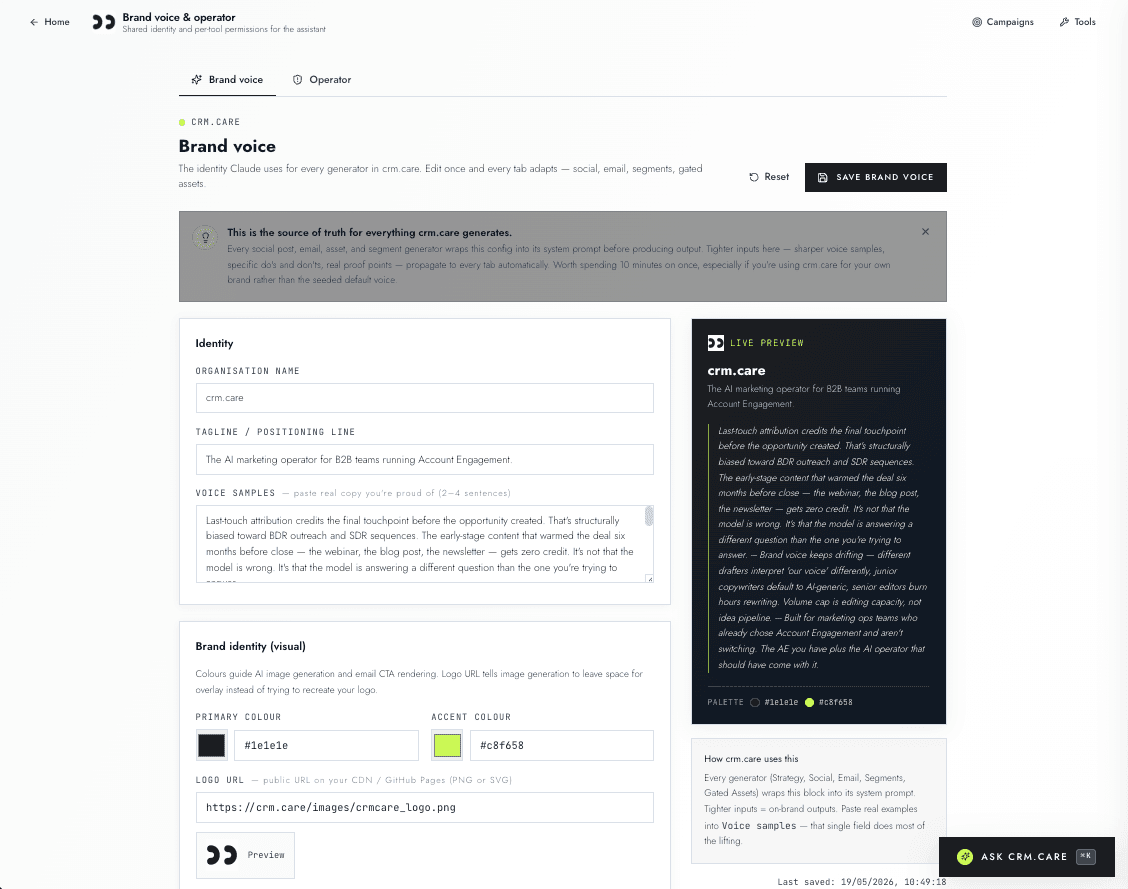
What gets configured
Voice samples — paste in two or three pieces of writing that sound right. A blog post. A founder LinkedIn post. A particularly on-voice email. The model uses these as reference texts.
Voice dos — short imperatives. 'Specific numbers, with units. "Six minutes," not "fast."' 'Light contractions in long-form, none in headlines.' 'Use "AE" or "Account Engagement" — never "Pardot" on first reference.'
Voice don'ts — what to avoid. 'No marketing-speak: no transformative, no next-generation, no powerful.' 'No exclamation marks. Ever.' 'Don't open a section with "Imagine".'
Plus target industries, competitors, proof points, primary + accent colour, and an optional logo for image watermarking.
Where it propagates
Every generator reads from the same brand voice. Strategy plans use the voice samples for tone calibration. Email subject variants get tested against the voice dos. Social posts inherit the proof points. SDR briefs use the don'ts list to avoid the language that would tip prospects off that the message is auto-generated. Gated assets keep the same voice across whitepapers, guides, and checklists.
Image generation reads the colour palette and applies it as composition guidance. Optional watermarking composites the logo onto generated images so a campaign's visuals are immediately identifiable as yours.
Iterate-on-output
Every generated asset has a 'what should change?' input. Type feedback in plain English — 'shorter and more sceptical', 'lead with the data point', 'fewer adjectives'. The model retains the brief and the brand voice across iterations. The output doesn't drift toward AI-generic on the second pass.
Optional website extraction: paste your brand site's URL, click Extract. Claude analyses the page and pulls colour palette, mood, photography style, and typography hints into the brand-voice config. Useful for the first-time setup; not required.
Why it matters
The 20-minute 'this doesn't sound like us' edit cycle compresses to two minutes. Multiply by ten assets a week. Senior editors get their afternoons back. The volume cap moves from editing capacity to idea flow — the only cap that should matter.
Once brand voice is configured, the marketing team can ship at junior-copywriter volume with senior-editor consistency. The bottleneck moves from review to ideation, which is where the team's strategic time actually adds value.
Related features
See it in your own workspace.
Free 7-day trial. No card. The brief flow takes about five minutes to ship your first campaign — and brand voice kicks in from day one.